

What Dsb Repair Mechanism Does Crispr Use?
"CRISPR-CAS9 is a revolutionary system of factor editing or genome editing that uses the guided RNA to carve the Dna at a specific location in a genome."
Editing a gene or Deoxyribonucleic acid for producing the desired phenotype was like a fairytale in the 80s, however, at present we tin can practise it. Tones of gene editing tools are at present bachelor, some are complicated & random whilst others are simple & precise.
Why are nosotros doing cistron editing? Might be the start question that will strike in your listen when you lot are thinking near factor editing. Information technology allows the states to create diverse genetically modified organisms , helps to treat genetic disorders and creates economically important plant species.
Several ways to do this are inserting, removing/ deleting sequences from the genome of an organism. CRISPR-CAS9 is one such tool, easy to utilise, highly accurate and precise.
Information technology allows researchers to manipulate the genome of any organisms similar animals, plants or microbes. It's a tool for genetic technology we can say, only more powerful than any other tools and techniques bachelor.
Put simply, CRISPR is a nucleic acid sequence and CAS9 is an enzyme that works together. Information technology needs a sgRNA or guided RNA to facilitate target-specific manipulation. The first explanation of the CRISPR-CAS9 system was demonstrated by Yoshizumi Ishino and co-workers in 1987.
Related article: What is gene editing and CRISPR-CAS9?
In the present article, we volition hash out the entire procedure of the CRISPR-CAS9 system and how you tin perform it in your lab, virtually. Still, what we volition hash out is totally different from the actual lab piece of work.
Furthermore, nosotros are not discussing the mechanism, instead, I will explicate the procedure stepwise, so that a newbie educatee tin can empathize it thoroughly. I hope this guide will add value to your knowledge of genetics,
Stay tuned,
Steps in CRISPR-CAS9:
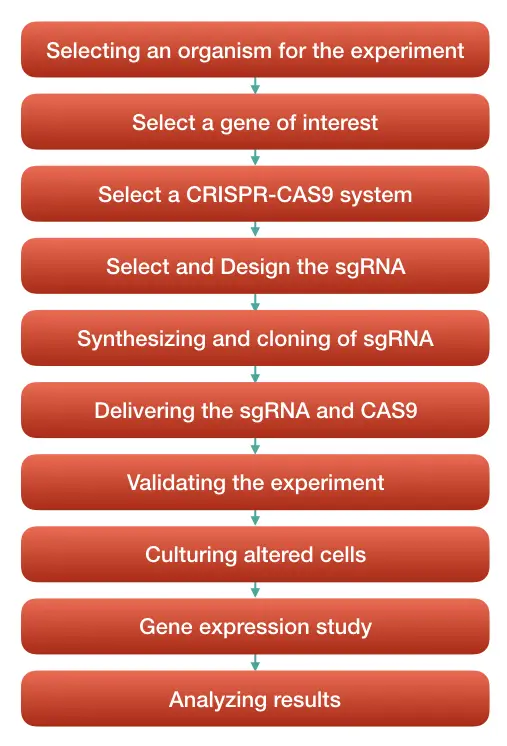
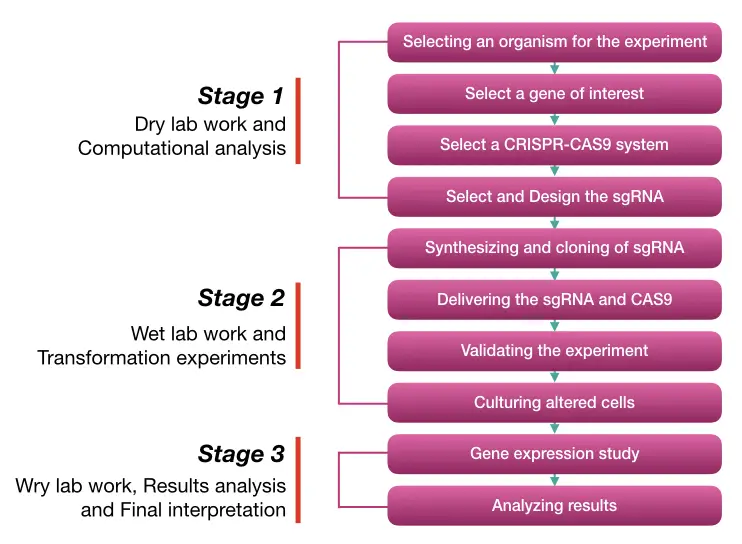
Several steps to apply the CRISPR-CAS9 system for gene editing and genetic engineering are:
- Select an organism for the experiment
- Select a cistron of the target location
- Select a CRISPR-CAS9 system
- Select and Design the sgRNA
- Synthesizing and cloning of sgRNA
- Delivering the sgRNA and CAS9
- Validating the experiment
- Culturing the altred cells
- Gene expression study
- Analyzing results
The CRISPR arrangement was commencement used to study gene knockout in which the cistron or Deoxyribonucleic acid sequence is removed from the model organism. Although, in recent trends, information technology has various applications in diverse fields.
We will endeavour to explain each pace in layman language and so that you can understand it well. Instead of going more into scientific writing, I will try to write in a simple language.
Steps and Procedure of CRISPR-CAS9:
Selecting an organism:
The very beginning step is to select an organism to edit. Nosotros can't perform gene editing for all organisms. Annotation that no CRISPR-gene therapy is withal approved 'fully' to dispense the man genome.
It tin can be efficiently used for plants but to use it in treating genetic disorders, starting time, we have to experiment on model organisms. If we are performing the CRISPR-CAS9 to treat genetic disorders, select the model organism whose genome is closely related to the human being.
For example the mice.
Selecting a gene or target location:
Now after selecting the model organism, the gene or the Deoxyribonucleic acid sequence we wish to study or alter or knockout is selected. Suppose we wish to written report the IGF gene.
Select that gene, clarify it, research data, observe sequence computationally do other bioinformatics analysis on this factor. Data assay will allow united states of america to understand whether this sequence tin can be manipulated or not.
Gather information of the length of the sequence, GC content, phenotype and phenotypic variations, SNPs, other mutations and factor expression. This information will help us to blueprint the guided RNA and locate the PAM sequence to edit a gene.
At present select a region to silence or remove.
Select a CRISPR-CAS9 system:
Non all the CRISPR-CAS9 systems can piece of work for all the manipulations. For example, to perform a knockout experiment nosotros take to select a nickase CAS9. Some of the CAS9 systems are enlisted below
- CAS9 nickase: Gene knockout, change in a sequence
- dCAS9: Activation and repression.
Some other CAS proteins are Cas13, Cas12, Csm, Cmr and RNase III. Different companies have different nomenclature for their own CAS protein.
Conclusively we can say nosotros take to select the CAS9 and CRISPR sequences based on our experimental requirements.
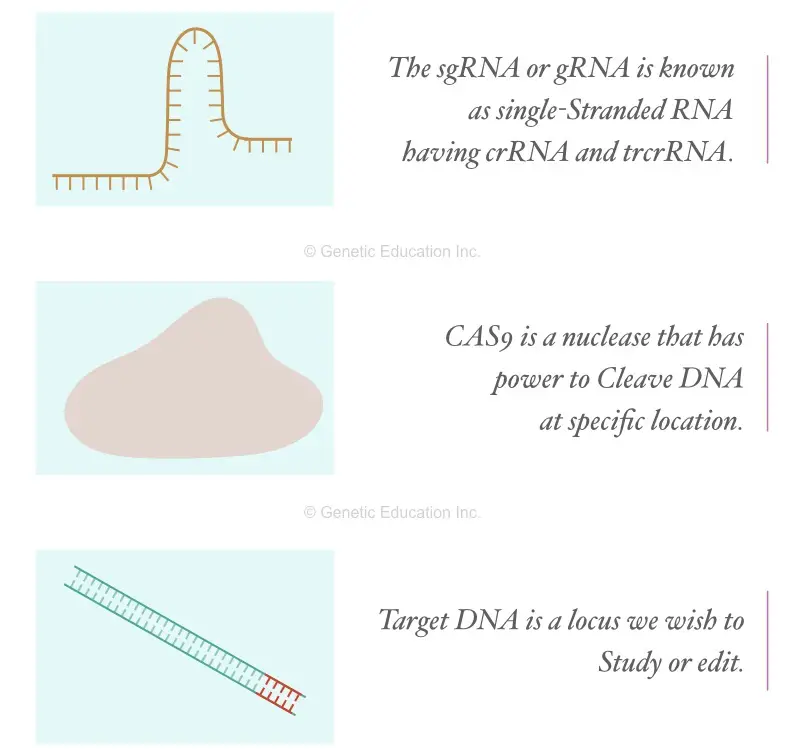
The CAS is a grade of protein known as the nuclease that can carve single-stranded as well equally double-stranded DNA.
Selecting and Designing the sgRNA:
sgRNA or gRNA is the curt RNA sequence that allows cistron editing by targeting a specific location. In the side by side step, nosotros accept to design the synthetic sgRNA, based on the sequence information bachelor.
Soon I am explaining what sgRNA is!
The sgRNA is a unmarried-stranded RNA known as a guided RNA having a complementary sequence to our target location. It is made up of two parts; the crRNA that has the complementary 20 nucleotides and the tracrRNA having the loop that recognizes the CAS9.
One time the tracrRNA part identifies the CAS, it guides the nucleus to the site of cleaving.
We need to design the sgRNA computationally. Showtime, based on the location of the PAM sequence, the sgRNA binding site is decided, commonly, upstream to the PAM.
We have covered an amazing article covering the whole process and tool to blueprint the sgRNA. Read it here: sgRNA- definition, mechanism and designing.
Once the gRNA is designed, we need to synthesize it and clone information technology in a plasmid.
Synthesizing and cloning of sgRNA:
We now have state-of-the-art facilities to synthesize the oligos of the gRNA or sgRNA in vitro . Only we have to gear up a stock or clone of it. To exercise and then, select the specific plasmid, insert the gRNA factor in it and develop several clones of it.
After that, isolate the gRNA expressed from the plasmid. Moreover, In vitro transcription also helps to synthesize the sgRNA. Once our gRNA is synthesized, CAS9 is ready to dispense the gene of interest.
Delivering the sgRNA and CAS9:
The electroporation method is widely used to insert the CAS9 and sgRNA into the target jail cell. Here, nether the influence of the current, pores are created in a prison cell that allows the nuclease and sgRNA intake.
Also, instead of CAS sometimes, mRNA specific to it or a factor is inserted to class a CAS9 in a host jail cell. Considering it is very hard to insert a CAS similar larger molecules.
Also, viral vectors similar adenovirus, Adeno-associated virus, lentivirus and retrovirus are used to perform the same function.
However to perform the transfection-mediated by the viral vector employ mRNA specific to the CAS. The virus itself forms the nuclease protein.
Other CRISPR-CAS9 commitment systems are microinjection, gene gun, sonication and chemical modifications.
At present our CAS and sgRNA are in the target jail cell.
Validating the experiment:
Now it'southward time to know whether the knockout occurs accurately or non, we should have to validate our experiment. Three common techniques are polymerase chain reaction , in vitro transcription or Dna sequencing.
Perform DNA sequencing prior to the experiment and afterward the completion of the experiment, and compare it. It lets us understand whether a gene is successfully removed or not.
PCR validates the experiment past amplifying the target from the modified cells. We accept explained the validation method in this section: sgRNA validation methods.
In addition to this, to validate the results nosotros tin likewise perform the restriction digestion experiment past inserting the restriction site at the target location.
Civilisation the contradistinct cells:
Now we accept a cell line of the altered prison cell which is genetically modified. Culture the jail cell line in aseptic atmospheric condition and using appropriate culture media. In one case sufficient amounts of prison cell lines are obtained, insert them into the target organism or organism we had selected for the experiments.
Annotation: don't estimate scientifically, information technology is only a simple explanation of the entire CRISPR-CAS9 mechanism.
How does the gap fill?
Nosotros have broadly discussed the procedure of knockout experiments in which we have removed several sequences. But a gap generated by the CAS9 nuclease activity tin can't remain unfilled.
A cell'due south Deoxyribonucleic acid repair mechanism repairs the Deoxyribonucleic acid or fills the gap by either Non-homologous end-joining or past directly Deoxyribonucleic acid repair. Here the Deoxyribonucleic acid polymerase fills the gap with nucleotides while the ligase forms the phosphodiester bail to fill up the gap.
But, wait for a minute!
The story does non yet end hither. We should have to perform several experiments to cheque the status of our contradistinct cells. Gene expression studies are ane among those many options.
Gene expression studies:
Nosotros take to check the expression of an contradistinct gene in all cell lines. Suppose we take inserted some DNA sequence, It will give united states of america an thought almost whether it is expressed in all cells or not!
RT-PCR or quantitative PCR is performed to check gene expression. Hither the mRNA is isolated from the cell line, reverse-transcribed into cDNA, and quantified in a PCR.
If you desire to learn more on cistron-editing and CRISPR-CAS9, yous tin can read our previous commodity on this topic:
What is factor editing and CRISPR-CAS9?
Analyzing results:
Results can be analyzed computationally as well equally by concrete examination. Computational tools assistance to analyze if everything is completed correctly or not, a gene sequence, gene expression contour etc.
- While the physical examination helps to understand,
- If a new phenotype is induced or non
- If the original phenotype still exists or not,
- If the phenotypic results are wrong or not.
Conclusion:
Briefly, this is the whole process of how a standard CRISPR-CAS9 experiment is conducted in a genetic lab. Nonetheless, the specificity of the results depends on which organization we have selected.
If we select the wrong CAS9, nosotros can't become the desired results.
SgRNA plays a crucial function in editing as well. If the sgRNA is not designed carefully, It will cleave untargeted regions in a genome. Therefore, which system nosotros are selecting decides what nosotros get!
If you are interested to learn more almost the CRISPR-CAS9 organisation. You tin read this article of Addgene: CRISPR guide.

Source: https://geneticeducation.co.in/explaining-crispr-cas9-system-step-by-step/
Posted by: martinrivinquister52.blogspot.com
0 Response to "What Dsb Repair Mechanism Does Crispr Use?"
Post a Comment